Posts

Bel Canto & Bellini

Image
Vincenzo Bellini's vocal writing epitomises the Italian Bel Canto ('beautiful singing') school of singing. The term describes the style of singing which embodies beauty and evenness of tone, smooth legato phrasing and perfection of technique.  Vincenzo Bellini (1801-35), painting by Granger. Image source Bellini was born on 3 November 1801 in Catania, Sicily. He came from a family of musicians (both his father and grandfather were organists of Catania Cathedral and maestri di cappella ), but a musical career was heavily opposed. Such was Bellini's ability, though, that friends of the family exerted pressure on his father to relent, and when the duke and duchess of San Martina offered to fund the young Bellini's studies at the Real Collegio di Musica di San Sebastiano in Naples, his father finally gave in.  Bellini was a diligent student, writing several sinfonias, masses, a cantata and his first opera. The opera was produced at the Conservatorium with such success t...

Throat Harmony

Image
Tuvan throat singing (known in Mongolian as 'throat harmony') is one particular variant of overtone singing practised by people in Mongolia, Inner Mongolia, Tuva and Siberia. In 2009, this art-form was inscribed on the Representative List of the Intangible Cultural Heritage of Humanity of UNESCO.  Tuva Image source Despite what the term might suggest, throat singing (in this context) does not strain the singer's throat. Tuvan throat singers can produce two or three, sometimes even four pitches simultaneously. The singer starts with a low drone. Then, by subtle manipulations of his/her vocal tract, the singer breaks up the sound, amplifying one or more overtones, just enough so that they can be heard as additional pitches while the drone continues at a lower volume.  Listen: DHM YouTube Playlist DHM YouTube Playlist The ancient tradition of throat singing developed among the nomadic herdsmen of Central Asia, people who lived in yurts, rode horses, raised livestock and had a ...

The Organ

Image
The organ is a keyboard instrument, operated not only by the player's hands, but also their feet. Pressurised air produces notes through a series of pipes. The term organ  encompasses reed organs and electronic organs but, unless otherwise specified, is usually understood to refer to pipe organs. Although it is one of the most complex of all musical instruments, the organ has the longest history and the largest and oldest extant repertoire of any instrument in Western music. In spite of substantial technical developments, the organ's basic principles of operation remain relatively unaltered from when they were discovered more than 2,000 years ago. Organs usually possess several sets of pipes (also known as stops or register), playable from several keyboards and a pedal board (operated by the feet).  Image Source The pipes are arranged over a wind chest that is connected to the keys via a set of pallets (or valves) and fed with a supply of air by electrically or mechanically ac...

Teresa Carreño

Image
Teresa Carreño was a celebrated Venezuelan composer, mezzo-soprano and, most notoriously, pianist, who was known for playing with great power and spirit. Teresa Carreño (born Dec. 22, 1853, Caracas, Venezuela - died June 12, 1917, New York City) Listen to her Elegia ( Elegy ), as recorded by Clara Rodríguez:  DHM YouTube Playlist Teresa Carreño was given her first piano lessons by her father, Manuel Antonio Carreño, a politician and talented amateur pianist. Exiled because of a revolution, the family settled in New York in 1862; there Carreño studied with Louis Moreau Gottschalk. After this, she spent four in Paris as a pupil of Georges Mathias and Anton Rubinstein, after which she embarked on a long and highly successful concert career. In addition to being a virtuoso pianist, she developed a mezzo-soprano voice of sufficient calibre to enable her to appear as an opera singer. With the second of her four husbands (the baritone Giovanni Tagliapietra), she organised and directed an ...

The First "Pieces" of Music

Image
Thoughts on Notation " People sang and played instruments long before ways of writing music down on paper were invented. Even today, nearly everyone can sing, though not everyone can 'read' music. Many people can also play instruments without being able to read a note of music: like some of the great jazz musicians, they play 'by ear'. Clearly, it is perfectly possible to make music without having it written down. Indeed, when one considers the world's music as a whole, one finds that the use of music notation  (written signs representing musical sounds) is actually quite rare. Many countries in the East, for example, have ancient musical traditions which are very beautiful and sometimes very elaborate, yet which make little (if any) use of notation. Their musicians scarcely ever learn from written-down music or use it when they are performing.  In Europe, however, the use of notation became central to the development of music. At first (well over a thousand ye...

Firebird

Image
In Slavic mythology and folkore, the Firebird (Russian: Жар-птица) is a magical and prophetic glowing bird from a faraway land, whose feathers convey beauty and protection upon the earth. The Firebird is described as a large bird with majestic plumage that glows brightly emitting red, orange, and yellow light, like a bonfire that is just past the turbulent flame. The feathers do not cease to glow, even once removed.  Firebird by Lev Lominago The Firebird ballet is based on this legend and was composed by Igor Stravinsky. It was first performed in Paris in 1910 and was the first international success of the composer's career. Interestingly, although the commission to write the ballet elevated Stravinsky to international renown, he was offered the commission for the newly formed Ballets Russes only after several prominent Russian composers had already rejected it. With the premiere at the Paris Opera quickly approaching, Sergey Dyagilev, the grand impresario of the Ballets Russes, ...

Ella Fitzgerald - The Virtuoso

Image
Ella Fitzgerald was an American jazz singer who became world famous for the wide range and rare sweetness of her voice. She became an international legend during a career that spanned some six decades. She is perhaps most well-known now for her beautiful renditions of jazz standards and ballads, but she generated a phenomenal energy in her live performances, especially when "Scat Singing". Ella Fitzgerald (April 25 1917 - June 16 1996) Scat singing (also referred to simply as "Scat") is a jazz vocal style using emotive, onomatopoeic and nonsense syllables instead of words in melodic improvisation. It gives the vocalist the possibility to sound like a variety of different instruments. Scat has dim antecedents in the West African practice of assigning fixed syllables to percussion patterns, but the style was made popular by trumpeter and singer Louis Armstrong from around 1927.  Listen to these epic live performances from Ella Fitzgerald: 1966 "How High the Moon...

Benjamin Britten - Violin Concerto

Image
As well as a pianist and conductor, Benjamin Britten was a leading composer of the mid-20th century, whose operas were considered the finest English operas since those of Henry Purcell (17th century). The prolific nature of Britten's operatic and vocal output makes it easy to forget that prior to the phenomenal success of his opera Peter Grimes  in 1945, he was primarily known as a composer of vividly orchestrated instrumental music.  His Violin Concerto was written from 1938 to 1939 and dedicated to Henry Boys, his former teacher at the Royal College of Music, London. It was premiered in New York, on 29 March 1940 by violinist Antonio Brosa with the New York Philharmonic conducted by John Barbirolli.  Listen to it here performed by Maxim Vengerov (violin) and conducted by Mstislav Rostropovich (for whom Britten wrote several cello works): DHM YouTube Playlist Benjamin Britten (November 22 1913, Lowestoft, Suffolk, England - December 4, 1976, Aldeburgh, Suffolk) Mstislav ...

Bossa Nova

Image
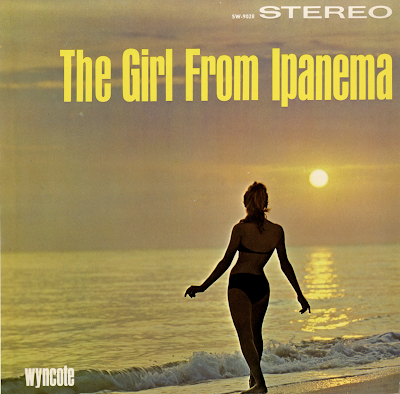
The Portuguese phrase "Bossa Nova" translates as "new trend" and defines the Brazilian popular music that evolved in the late 1950s from a fusion of samba (a Brazilian dance and music) and cool jazz. The composer Antonio Carlos Jobim and the guitarist Jo ã o Gilberto may be considered the founders of this style. Instrumentation can be varied but is purposely simple, limited to a few rhythm instruments. In vocalized passages, the musical background becomes more subdued to allow the singer to improvise over the top. As a dance, the bossa nova differs little from the samba, requiring the same subtle body rhythm and two-step foot movement. Listen to Jobim's Garota de Ipanema (The Girl from Ipanema): DHM YouTube Playlist Listen to the same song as performed by Astrud Gilberto (singer and wife of Jo ã o as of 1959), Jo ã o Gilberto (guitar) and Stan Gertz (saxophone): DHM YouTube Playlist Another famous song is Mas que nada , written by Jorge Ben Jor, which has elemen...

Henry VIII

Image
On the 28th June 1491, Henry VIII was born. He was King of England, married six times, initiated the English Reformation and appointed himself the Supreme Head of the Church of England. On top of this, the monarch also found the time to write some music.  Listen to O My Heart as performed by the Hilliard Ensemble: DHM YouTube Playlist All of the Tudor and Stewart monarchs were musical and took a personal interest in the professional performers at their courts. Some of these court musicians were well-known, such as Robert Fayrfax, organist of St Alban's Abbey and first doctor of music at Cambridge, who served under Henry VIII.  Henry VIII (28 June 1491 - 28 January 1547) Of his family, Henry VIII was probably the most musically gifted. He played numerous instruments: the lute, the organ, recorders, the flute, the harp and he had a good singing voice. He also owned an enormous collection of instruments: cornets, bagpipes, viols, lutes, flutes shawms (a double-reed woodwind inst...

Rebecca Clarke

Image
The composer Rebecca Clarke was born and raised in England, with a German mother and an American father.  Image source Rebecca Clarke (27 August 1886 - 13 October 1979) As well as being a composer, she was a highly regarded violist and contributed greatly to the viola repertoire, including a piece called "Morpheus". Morpheus is a god associated with sleep and dreams. In Ovid's Metamorphoses he is the son of Sleep, and he appears in dreams in human form.  Listen to this entrancing piece: DHM YouTube Playlist Clarke enrolled at the Royal Academy of Music in 1903, where she studied the violin. She was abruptly withdrawn from the institution in 1905, when her harmony teacher, Percy Miles, proposed marriage. In 1907 she began a composition course at the Royal College of Music, where she was Stanford's first female student. Again, she was unable to finish her studies, as her habitually cruel father suddenly banished her from the family home. To support herself, Clarke embar...

Ludwig van Beethoven - Pastorale

Image
The year 2020 marks the 250th anniversary of Beethoven's birth year (1770).  The Symphony No. 6 in F major, also known as the Pastoral Symphony (German: Pastorale) is a symphony composed by Ludwig van Beethoven and was completed in 1808. The symphony has five movements (rather than the typical four).  Listen to them here: I. "Erwachen heiterer Empfindungen bei der Ankunft auf dem Lande" ( "Awakening of cheerful feelings on arrival in the countryside" ): DHM YouTube Playlist II. "Szene am Bach" ( "Scene by the brook" ): DHM YouTube Playlist III. "Lustiges Zusammensein der Landleute" ( "Merry gathering of country folk" ): DHM YouTube Playlist IV. "Gewitter, Sturm" ("Thunder, Storm") & V. "Hirtengesang, Frohe und dankbare Gef ü hle nach dem Sturm" ( "Shepherd's song. Cheerful and thankful feelings after the storm" ): DHM YouTube Playlist Ludwig van Beethoven Born on the 15th or...

Jacobus Clemens (non Papa)

Image
Jacobus Clemens, a.k.a. Clemens Non Papa, was likely born circa 1510 in Flanders. The addition of "non Papa" to his name, literally means "not the Pope", the pope in Rome at the time being Clement VII. However, the nickname could have also been a reflection of the composer's protestant sympathies.  Jacobus Clemens (c.1510 - 1556) Around the time of his birth, Michelangelo was starting work on the Sistine Chapel in Italy and in England, Henry VIII saw the completion of Hampton Court Palace. However, the centre of musical stylistic innovation was the Netherlands, dominating the scene throughout the renaissance. Clemens non Papa was one of the few successful Flemish musicians not to travel to Italy, spending most of his life in Flanders, working in towns such as Bruges, Dordrecht and Ypres. Also, unlike most other composers of that period, Clemens non Papa seems never to have been employed by the church, at least not on a permanent contract. Nevertheless, owing to ...

Nina Simone

Image
On the 24th of June, 1958, Nina Simone released her debut jazz album "Little Girl Blue".  Nina Simone (original name Eunice Waymon) February 21 1933, North Carolina, U.S. - April 21, 2003, Carry-le-Rouet, France) Listen to the track "Little Girl Blue" here (it starts with a tune you may recognise): DHM YouTube Playlist Nina Simone began playing the piano and organ as a girl. Her awareness of racism was acutely heightened at the age of 12, when she gave a piano recital in a library where even her own parents had to stand at the back, because they were black.  Simone was a student of classical music at the Julliard School of Music (New York City) and began performing as a pianist. Her vocal career began in 1954 in a nightclub, when the owner of the club threatened to fire her unless she sang too.  "I had travelled North to Philadelphia and a friend of mine told me of an engagement in Atlantic City. Well, he contacted the owner and successfully achieved that goal....

Kaddisch

Image
Maurice Ravel: "Kaddisch" from Deux Mélodies Hébraiques ( Two Hebrew Melodies ) The Kaddish, also spelled Qaddish, in Judaism, is a doxology (hymn of praise to God) that is usually recited in Aramaic in all synagogue services. The nucleus of the prayer is the phrase: Glorified and sanctified be God's great name throughout the world which He has created according to His will.  May He establish His kingdom in your lifetime and during your days. The congregation responds (this section being omitted from Ravel's version): May His great name be blessed forever to all eternity.  Originally, the Kaddish was recited in the rabbinical academies at the conclusion of public study or after the sermon of the preacher. In time it became a regular feature of the synagogue service. The prayer also expresses the plea for the quick realisation of the messianic age: and, because the resurrection of the dead is associated with the coming of the Messiah, the Kaddish eventually became the ...

Fascinating Rhythm

Image
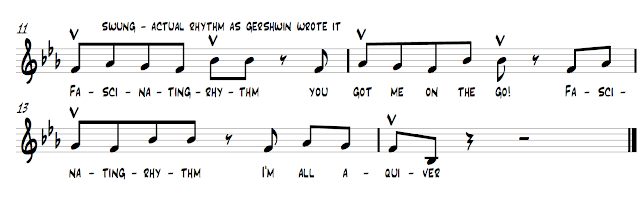
And we're back with Fascinating Rhythm by George Gershwin!  We're offering you a few versions of this gem: The original, performed by Fred & Adele Astaire with Gershwin on piano: DHM YouTube Playlist Tommy Dorsey Orchestra:  DHM YouTube Playlist Jacob Collier's version:  DHM YouTube Playlist What is so fascinating? So, the first thing we need to understand is that the rhythm in this piece is "swung", meaning that "straight" quavers sound more like the top line (x), tripletised, so that the second note of each pair of swung quavers tucks in a quaver triplet before the next beat: See this for more on swung rhythms. "Swinging" rhythms is a standard way of performing jazz music. However, what's more "fascinating" about this chorus melody is how it subverts our expectations, especially by playing with unexpected rhythmic emphases.  Conventionally, such a melody might be written like this: two, 2-bar (sub)phrases in 4/4 time with r...